The conundrum illustrated geographically:  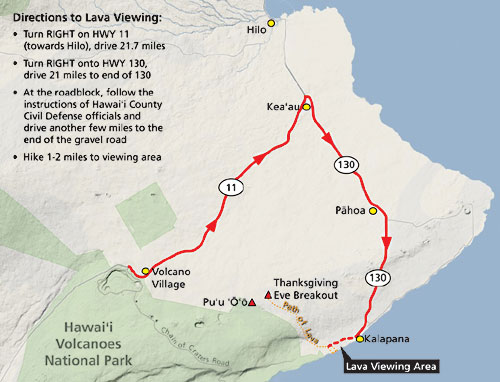 |
What are the other cool things to do in Puna? Pahoa Town – a charming place to grab snacks or do a little shopping. People rave about the Mexican restaurant Luquin's here. Liloki margaritas for me and pigs raised by the restaurateur for the ultimate in locally grown for Charlie. |
Kahopo Pool – another geothermically warmed pool, way lesser known than the Ahalanui Park, couldn't even find a picture. Cape Kumukahi Light House - No picture of these either, but it's near the sea pool and is home to the world's freshest air. |
See all these things on the map:   Another solution to our timing conundrum might be to just do the helicopter tour. People tell me it’s the best money you can spend on the island and it’s not as pricey as I would have thought. Flights leave every hour until 4:30 pm from Hilo. We miss out on the night viewing, but I don't know that we need it given we get so close to the lava. I'm still not sure how that would time out in our itinerary, but it would be cool. I also still kind of want to go kayaking and horseback riding too. And maybe on a catamaran. Yikes. No money for food on this trip! LOL. Another solution to our timing conundrum might be to just do the helicopter tour. People tell me it’s the best money you can spend on the island and it’s not as pricey as I would have thought. Flights leave every hour until 4:30 pm from Hilo. We miss out on the night viewing, but I don't know that we need it given we get so close to the lava. I'm still not sure how that would time out in our itinerary, but it would be cool. I also still kind of want to go kayaking and horseback riding too. And maybe on a catamaran. Yikes. No money for food on this trip! LOL. |
Saturday, August 7, 2010
The Puna District and the Lava Viewing Conundrum

Friday, August 6, 2010
Volcano Day
Inside the park, there are two main areas to see – the Kilauea Caldera and the Chain of Craters Road. There is also a 30 mile round trip drive to a very high lookout on Mauna Loa, which could be cool especially since on route there is a hike that is supposed to be good birding.
Everyone recommends we start at the Visitor’s Center to get the scoop on conditions and watch a video, which really I could skip in favor of seeing the real thing. It’s a 30 minute drive from our hotel to the center. It opens as early as 7:45 am. It’s on Crater Rim Drive, where everything seems to be. Adjacent to the Visitor’s center are a number of trailheads and the Volcano Arts Center. I am thinking we will prefer more short hikes over one long one, in which case there is one trailhead here that could be cool, but isn’t my highest priority. It’s the Iliahi or Sandalwood Trail, a shady 1.5 mile loop with a view of the caldera.

Crater Rim Drive West of the Visitors Center boasts the most active volcanic overlooks. There are three and the closest to the steam vent is at the Jaggar Museum (no admission fee).

Mauna Loa Road – I’m not sure about the long drive up to the lookout. I think it is mainly for people who are going to backpack to the summit. I suppose if it’s clear it could be great? Two things on the road though that I do want to do: Kipukapuaula Bird Park Trail – a lovely shady 1 mile loop for birding. People have said “dress in khaki like a ranger and the pheasant walk right up to you.” Also cool sounding is the tree mold exhibit, where lava burnt a tree, but the hole is there. Nearish to here is the Volcano Winery, which of course we have to go to. It’s open from 10-5:30.
If we do prefer a longer hike, the 4 mile Kilauea Iki Trail through the crater sounds like a winner.
Monday, July 26, 2010
South Point
The next place we stay is in the South Point area. Sea Mountain is adjacent to the black sand beach of Punaluu. More exciting than the black sand is that this is a favored spot for the area sea turtles, who enjoy sunning themselves on the super warm sand.
Apparently, South Point is pretty remote, but there are a few other things that we may want to check out in addition to the Volcanoes National Park:
I think there are actually only two places to eat in the area, but they both sound good, still we will probably need to cook some when we stay here:
Shaka restaurant - famous for plate lunch
Punaluu Bake Shop - famous for baked goods
Monday, July 5, 2010
Loose Itinerary for First Few Days
DAY 1 - Arrive Kailua-Kona, walk around town, see some of the historic sights, get lunch at the brewery, get groceries, head to hotel to check-in for the night. Buy boogie boards?
Day 2 - Birding
Day 3 - Morning at Kahaluu Beach Park, lunch at Ba-Le, coffee plantation tour, birding at Kaloko-Honokohau.
Day 4 - Drive Highway 11 South to State Highway 160, stop to admire Kealakekua Bay, follow City of Refuge Road to Pu'Uhonua O Honaunau National Historical Park, snorkel at two step or continue on 160 to Highway 11, stop by the painted church and the free Wakefield Botanical Gardens if it looks nice, fortify at south kona fruit stand if the mood strikes us or at Royal Kona Coffee Visitor Center or any of the many other stands we see. Things will become more scarce the further towards our hotel we get. I'll post more about that area later.

Day 2 - Birding
Day 3 - Morning at Kahaluu Beach Park, lunch at Ba-Le, coffee plantation tour, birding at Kaloko-Honokohau.
Day 4 - Drive Highway 11 South to State Highway 160, stop to admire Kealakekua Bay, follow City of Refuge Road to Pu'Uhonua O Honaunau National Historical Park, snorkel at two step or continue on 160 to Highway 11, stop by the painted church and the free Wakefield Botanical Gardens if it looks nice, fortify at south kona fruit stand if the mood strikes us or at Royal Kona Coffee Visitor Center or any of the many other stands we see. Things will become more scarce the further towards our hotel we get. I'll post more about that area later.
Saturday, July 3, 2010
Historic Kona
Kona and the area to the south are well known for Hawaiian historical sights. There are two main museums run by the Kona Historical Society, including a coffee museum. The main museum features a historic store and a Portuguese stone oven.
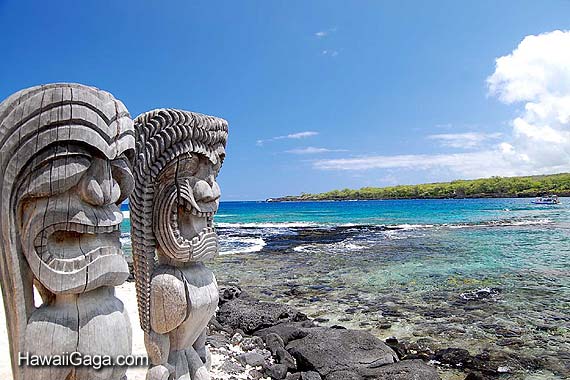 The most significant historic spot we won't want to miss is the Place of Refuge, which is now a national park. The park system describes its significance as a place where all Hawaiians could come to seek sanctuary. It also includes royal grounds, an historic village, and the site where criminals were punished. One cool thing the park features is an audio tour available by phone.
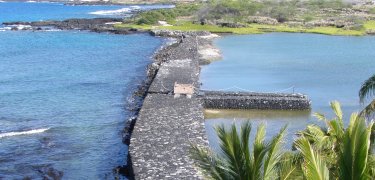
North of the Kailua-Kona town is Kaloko-Honokohau National Historic Park, which is the remains of an ancient fishing settlement. Many of the aquaculture ponds are still in tact, so I think this might be a good birding spot.
We also might want to stop by the Painted Church while we are in coffee country. It's named for the paintings adorning the inside walls, painted by the original father of the church, the church was built in 1899 and is very pretty on the outside as well. A Hawaiian blogger has written about this historic area in detail. He describes a cool petroglyph area near the Keauhou resorts, but it sounds like the tide makes them difficult to see. There's also Captain Cook's monument, but the hike sounds like an ordeal. You can see it from one of the snorkel tours I mentioned before.
The most significant historic spot we won't want to miss is the Place of Refuge, which is now a national park. The park system describes its significance as a place where all Hawaiians could come to seek sanctuary. It also includes royal grounds, an historic village, and the site where criminals were punished. One cool thing the park features is an audio tour available by phone. North of the Kailua-Kona town is Kaloko-Honokohau National Historic Park, which is the remains of an ancient fishing settlement. Many of the aquaculture ponds are still in tact, so I think this might be a good birding spot.
We also might want to stop by the Painted Church while we are in coffee country. It's named for the paintings adorning the inside walls, painted by the original father of the church, the church was built in 1899 and is very pretty on the outside as well. A Hawaiian blogger has written about this historic area in detail. He describes a cool petroglyph area near the Keauhou resorts, but it sounds like the tide makes them difficult to see. There's also Captain Cook's monument, but the hike sounds like an ordeal. You can see it from one of the snorkel tours I mentioned before.
Friday, July 2, 2010
Kona Coffee
 Since Charlie and I are coffee's biggest fans, we will probably want to take in a coffee plantation tour. I believe Kona is the only place in the United States that coffee is grown, which is really the number one reason why I could never do the 100 mile diet despite wanting to be a green girl. Hmm. I'm not going to think too hard about that, but instead say that wikipedia identifies Kona Coffee as the most expensive and sought after in the world. Yum. It's grown on the volcanic slopes of Hualalai and Mauna Loa, which makes it more exciting by nature.
 BTW the native Hawaiian language has several fewer letters than the alphabet we use. I am absolutely mystified as to how to pronounce most of the words. If I were going to say Hualalai aloud while driving, I would say look for the H word with several A's and good luck figuring out which H word I mean. Or maybe I would just spell it.
 So coffee, obviously we will be drinking Kona every morning, but we might want to do a coffee plantation tour and there are several options:
Mountain Thunder is actually clear on their website about what time tours happen and what happens on a tour. I like that.
Kona Joe's might be a good place to stop on our drive south to our next overnight spot, but you have to call ahead to request the actual tour and then you have to pay.
Kona Blue Sky Coffee Visitor's Center is quite close to our Kona residence, so this would be an easy stop to make. It's not clear from the website what is at the visitor's center though.
Kona Lea Plantation is further south, Kona Lea Plantation sounds awesome - it's organic, plus they have a tour and a flock of geese.
Kona Coffee also has macadamia nuts going for it, it's pretty far south.
Though I question the name, Bong Brothers has a road side stand that sounds like it's worth stopping at for Hawaiian treats and Kona coffee.
Some of the further south places would be better visited while driving to our hotel in Punaluu, but some might be good to check out in between beaches on our water day.
Monday, June 28, 2010
Water Fun on the Kona Coast
 Kona has a few great options for water fun - tiny White Sands Beach for boogie boarding or snorkeling at Kahaluu Beach Park, which is very popular and may require an early start to get a spot. If we opt for these DIY adventures, we might want to pick up Banh Mi in town at Ba-Le Sandwich Shop, before we hit the beach. Another from land option is further south near the place of refuge, called two-step beach.
From what I've read, there are quite few more snorkel options if you boat to the snorkel location. The Kealakekua Bay is supposedly awesome and full of fish, but only one company seems to go there daily and the boat is motorized and their website annoys me. Plus I don't know that we will want to go on another tour. The plus side to touring though is we don't have to pack our own gear, BYOGear would likely mean no carry-on luggage option for the flight.
 Kayaking also seems like a super fun option. Aloha Kayak offers tours of Keahou Bay or the City of Refuge. These include lava tubes and caves as well as snorkel stops. Again this is another tour, but perhaps a bit more independent and no gear required.
 Also intriguing are the night time Manta Ray snorkels. Hmm. That sounds rather unique, but how do you see at night and how close do the rays come? I know they aren't sting rays, but I worry a little since the death of the crocodile hunter. Yet, I don't want to pass up an opportunity to see something cool. It seems like several companies offer the night time snorkels at varying prices, but I can't tell if in the end you are going with the same dive shop on all of them. Kona Honu Divers is currently offering a package that you can use at different times, which includes both an evening manta ray snorkel and a morning dolphin snorkel. But this package doesn't time out as well as I'd like with our time in Kona.

Subscribe to:
Posts (Atom)